Project Name: The Pinckney Commonwealth Campus
Location: Village of Pinckney, Livingston County, Michigan
Development Overview: Integrated Master-Planned Mixed-Use Campus
Project Scope & Programmatic Pillars
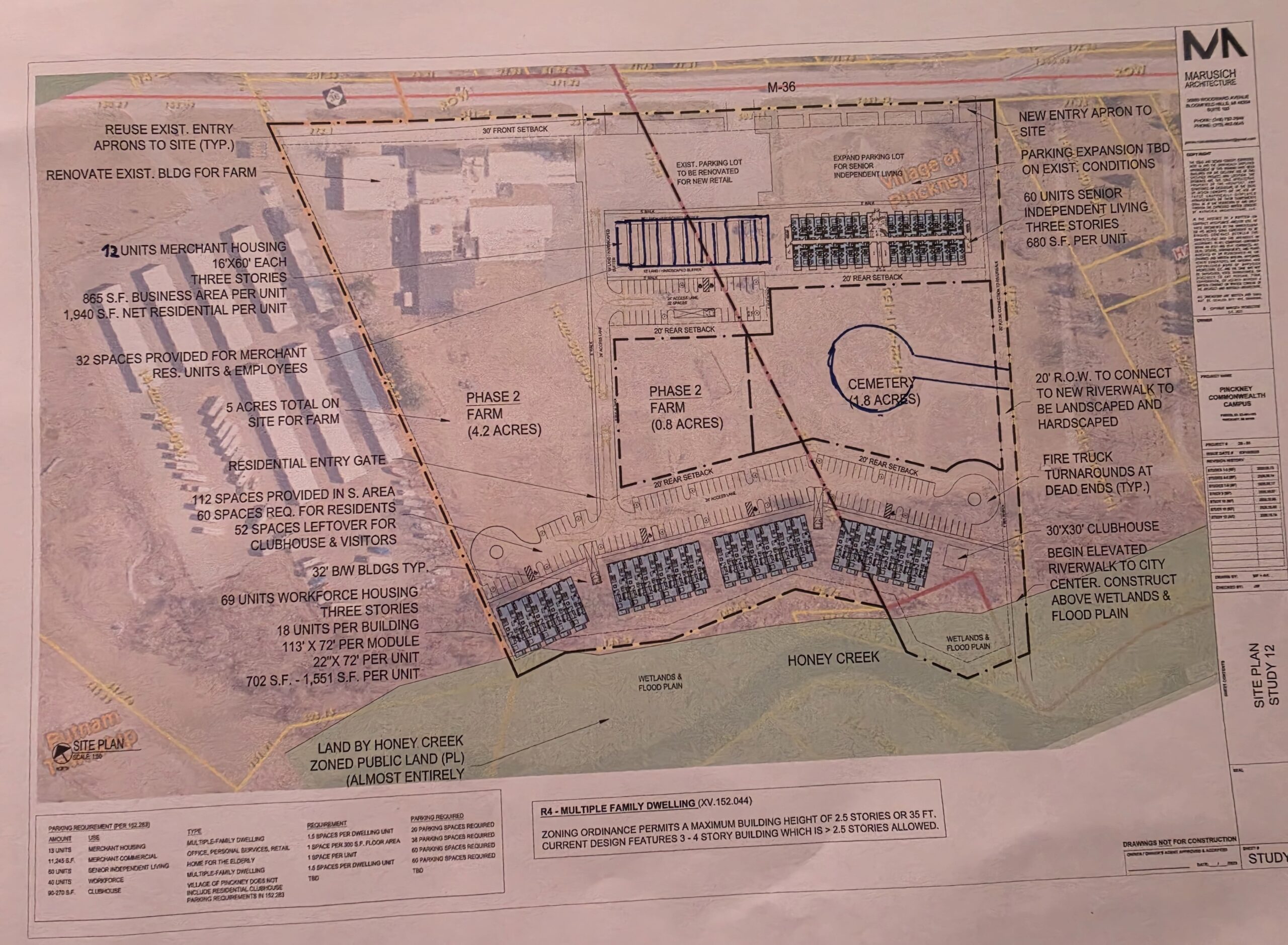
The Pinckney Commonwealth Campus is a master-planned, multi-generational development designed to integrate affordable workforce housing, senior independent living, ground-floor merchant/commercial spaces, and a state-of-the-art controlled-environment sustainable indoor farm.
- Workforce Housing: Multi-family residential units designed for local working individuals and families earning between 60% and 120% of Area Median Income (AMI).
- Senior Independent Living (55+): Active, accessible independent residential apartments designed for seniors on fixed or moderate incomes, offering integrated accessibility features and proximity to campus amenities.
- Merchant & Retail Housing (Mixed-Use): Ground-floor storefronts and commercial suites with upper-story residential options, designed to support local small businesses, artisans, service providers, and campus enterprises.
- Sustainable Indoor Farming: An urban Controlled Environment Agriculture (CEA) facility utilizing hydroponic or vertical farming systems to deliver hyper-local food production, job training, and year-round food security.
Available Financing Structure: State & Federal Capital Stack
Given the multi-faceted nature of the campus, financing can be layered through specialized federal and state capital sources:
Federal Financing Mechanisms
- U.S. Department of Housing and Urban Development (HUD): Section 221(d)(4) multi-family construction loans and HUD Section 231 senior housing guarantees providing non-recourse, long-term fixed-rate debt.
- USDA Rural Development Loans: Community Facilities Direct Loans and Guaranteed Loans available for rural/village infrastructure, food access, and essential community facilities.
- USDA Rural Energy for America Program (REAP): Direct capital grants (up to 50% of eligible project costs) and loan guarantees for clean energy systems and energy-efficient equipment installed in the indoor farm.
- USDA Urban Agriculture & Innovative Production (UAIP) Grants: Federal grant awards ranging from $50,000 to $350,000 to cover planning, equipment, and infrastructure for controlled-environment agriculture.
State Financing Mechanisms (State of Michigan / MEDC / MSHDA)
- Michigan State Housing Development Authority (MSHDA): Tax-exempt bond financing and low-interest soft loans (such as the HOME Investment Partnerships Program and Housing Trust Funds) dedicated to workforce and senior residential development.
- Michigan Economic Development Corporation (MEDC): Michigan Revitalization and Expansion Program (MCRP) performance-based grants and loans for mixed-use, downtown-adjacent catalyst real estate projects.
- Michigan Department of Agriculture and Rural Development (MDARD): Rural Development Fund grants and Agricultural Processing Grants to offset capital infrastructure costs for indoor farming operations.
Available Tax Credit Programs
| Tax Credit Program | Applying Component | Financial Impact / Benefit |
|---|---|---|
| Low-Income Housing Tax Credit (LIHTC) | Workforce & Senior Housing | 4% or 9% federal tax credit generating primary equity over 10 years via MSHDA allocation. |
| Section 48 Investment Tax Credit (ITC) | Sustainable Indoor Farm & Campus Renewables | 30% to 50% federal tax credit on solar, geothermal, or energy storage equipment investments. |
| Section 179D Commercial Buildings Energy Deduction | Entire Built Campus | Up to $5.00+ per sq. ft. tax deduction for high-efficiency HVAC, lighting, and building envelope design. |
| Federal & State R&D Tax Credits | Indoor Sustainable Farm | Offsets income/payroll taxes for proprietary growing recipes, climate automation, and water recirculation systems. |
| Local PILOT & Tax Increment Financing (TIF) | Village / Township / County | Payment in Lieu of Taxes (PILOT) to cap property taxes; TIF captures future value gains to reimburse public infrastructure costs. |
Campus Ecosystem & Community Impact Statement
The Pinckney Commonwealth Campus creates a self-sustaining, circular ecosystem where housing, economic opportunity, wellness, and environmental stewardship intersect. By integrating multi-generational housing alongside sustainable indoor agriculture and merchant space, the project creates a closed-loop community model:
- Food Security & Wellness: Fresh greens and produce cultivated inside the farm directly supply senior independent living dining, local workforce residents, campus merchants, and surrounding local food pantries.
- Economic Synergy: Ground-floor merchant units keep capital circulating locally, while the farm and mixed-use spaces create local green jobs, agricultural technician roles, and retail opportunities.
- Intergenerational Community: Pairing active senior independent living with workforce families creates a natural support network, providing stability for elders while giving local workers access to high-quality housing in Pinckney.
Get Involved: Resident, Employment & Investor Contacts
Whether you are looking to secure housing, pursue local career opportunities, or participate in the capital formation of this multi-faceted development, connect with project leadership:
- Prospective Residents & Commercial Tenants: Inquiries regarding upcoming leasing phases, income qualification guidelines for workforce/senior housing, or ground-floor retail leasing.
- Employment & Workforce Opportunities: Applications for agricultural operations, facility management, administration, and campus services.
- Investors & Capital Partners: Inquiries regarding equity participation, tax credit syndication, impact investment, or debt financing opportunities.
Primary Contact Information:
- Development Entity: Pinckney Commonwealth Campus Project Office
- Phone Direct: 704-352-3258
- Web Portal: pinckney.cc