PINCKNEY, Mich. — The Pinckney Commonwealth Campus announced today the field deployment and testing of an experimental, river-powered generator system designed to explore renewable, off-grid power solutions—including localized green hydrogen production—for sustainable community farming and indoor agriculture.
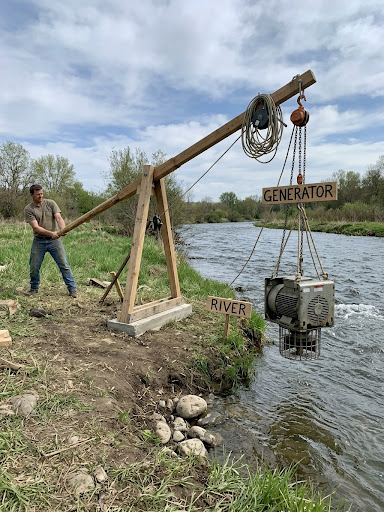
Positioned along local flowing waters, the pilot project evaluates a run-of-the-river hydrokinetic turbine system. Suspended from a counterbalanced timber derrick engineered for zero-disruption site installation, the modular submerged generator captures the kinetic energy of natural river flow without requiring dams or water diversion.
The continuous base-load energy generated by the turbine is designed to power the campus’s emerging sustainable farming infrastructure, including climate-controlled greenhouses, aquaculture tanks, and microgreen cultivation. Excess mechanical and electrical energy is directed toward experimental water-electrolysis testing, demonstrating how small-scale hydropower can produce and store on-demand green hydrogen fuel to power agricultural machinery and backup campus microgrids.
“Sustainable agriculture requires an equally resilient, closed-loop energy strategy,” said project coordinators at Pinckney Commonwealth Campus. “By tapping into natural, low-impact hydrokinetics right on our doorstep, we are creating a working living laboratory. This deployment demonstrates how community-scale farms can decentralize their energy needs, generate clean power around the clock, and integrate cutting-edge green hydrogen storage directly into modern food production.”
Key Highlights of the Experimental System:
- Zero-Dam Run-of-River Turbine: Employs a submersible kinetic turbine suspended directly into the active flow channel, eliminating the ecological disruption of impoundments or concrete dams.
- Modular Timber Rigging: Features a traditional, low-embodied-carbon cantilever crane assembly designed for rapid deployment, riverbank maintenance, and seasonal height adjustment.
- Hydrogen & Microgrid Compatibility: Converts continuous water flow into electrical capacity capable of supporting localized hydrogen electrolysis, high-efficiency lighting, and irrigation pumps.
- Scalable Agri-Energy Model: Acts as a proof-of-concept for smallholders, eco-villages, and rural farmsteads seeking clean, self-reliant utility models.
Testing and data collection will continue through the upcoming agricultural cycles to evaluate energy yields, river-flow seasonal fluctuations, and hydrogen conversion efficiencies.
About Pinckney Commonwealth Campus
The Pinckney Commonwealth Campus, located at 935 W. M-36 in Pinckney, Michigan, is an integrated community initiative pioneering the convergence of sustainable living, learning, and local agriculture. Envisioned as a multi-faceted hub featuring workforce and senior housing, mixed-use community spaces, and eco-conscious food production, the campus serves as a living laboratory for community resilience and ecological stewardship.
Media & Project Inquiries:
Pinckney Commonwealth Campus
Email: post@pinckney.cc
Website: pinckney.cc
Phone: (704) 352-3258